siteTitle

40,000 BCE

siteTitle

40,000 BCE — Now

heroSubtitle

scrollDown

The First Marks

~40,000 BCE

Cave Paintings
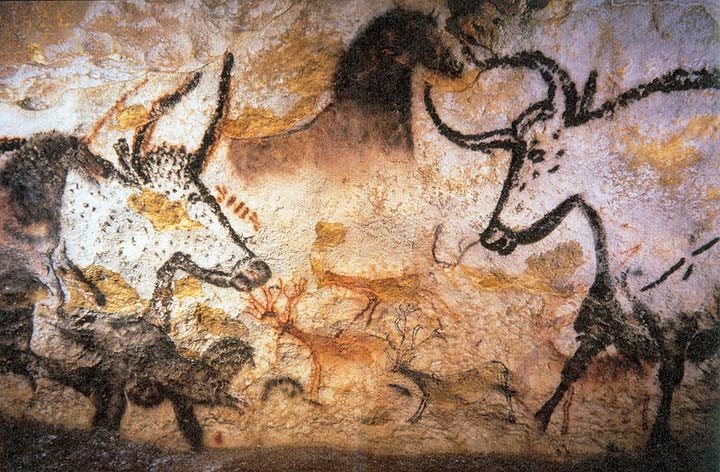
Lascaux cave painting depicting horses and aurochs
Wikimedia Commons, Public Domain

In the caves of Lascaux (France, ~17,000 BCE) and Altamira (Spain, ~36,000 BCE), early humans painted vivid depictions of horses, bison, and deer using mineral pigments. Hand stencils — made by blowing pigment around a pressed hand — appear across sites from Indonesia to Europe. These images were not decoration; they were humanity's earliest attempts to encode meaning onto a surface.

learnMore

The oldest known cave art was found on the island of Sulawesi, Indonesia, dated to at least 45,500 years ago. Similar hand stencils appear in France, Spain, Argentina, and Australia — suggesting that visual mark-making arose independently across multiple human populations, not from a single origin point.
~8,000 BCE

Clay Tokens

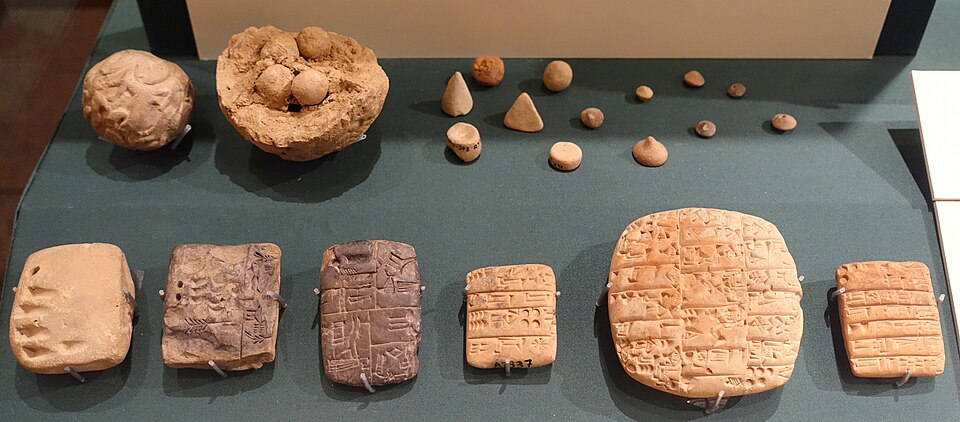
Clay accounting ball with calculi and counters, Oriental Institute Museum
Wikimedia Commons, CC BY-SA

In Mesopotamia, people shaped small clay tokens — cones, spheres, discs — each representing a quantity of grain, oil, or livestock. Archaeologist Denise Schmandt-Besserat (University of Texas) demonstrated that when these tokens were pressed into clay envelopes to create records, the resulting impressions evolved directly into the first written symbols. Writing was born from bookkeeping.

learnMore

The tokens were used for over 4,000 years before evolving into writing. Around 3,500 BCE, people began enclosing tokens in hollow clay balls (bullae) and impressing their shapes on the outside as a record. These surface impressions eventually replaced the tokens themselves — becoming the pictographs that led to cuneiform.

Ancient Writing Systems

~3,300 BCE

Cuneiform

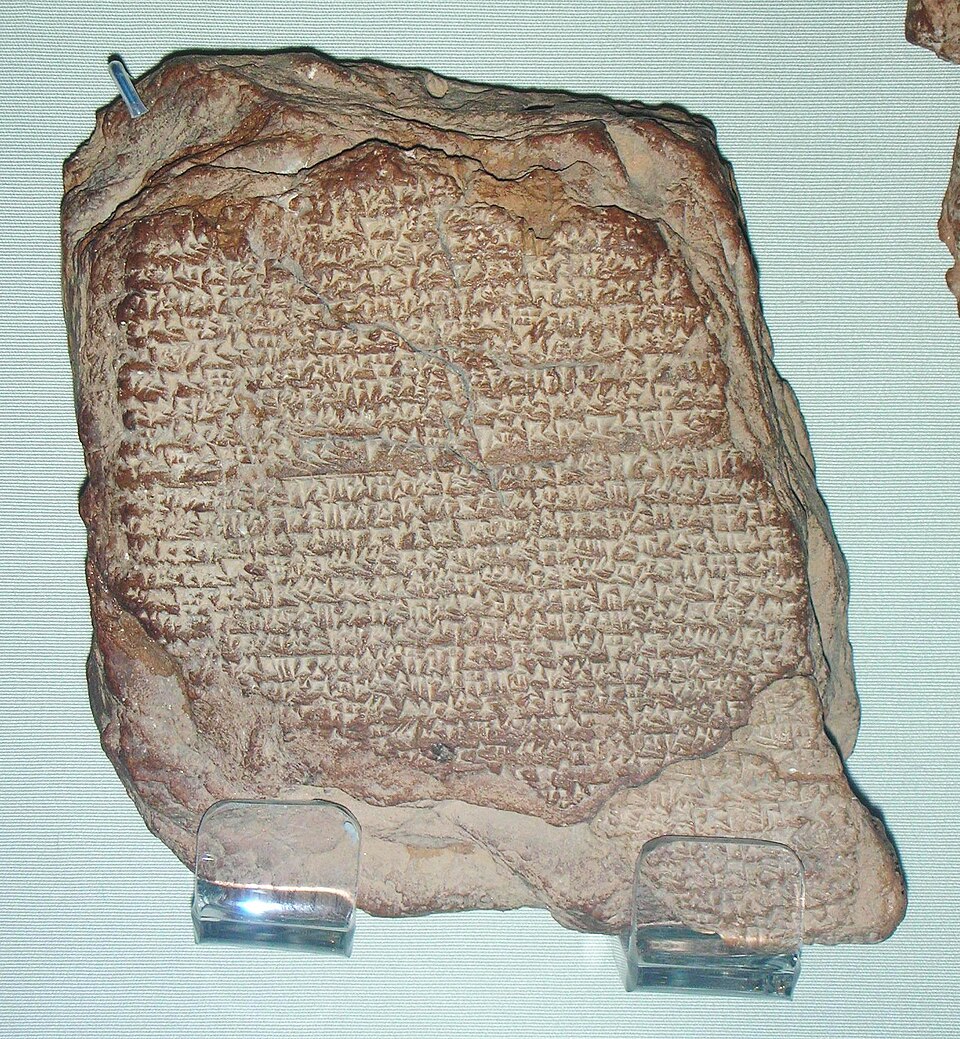
Cuneiform tablet recording observation of Halley's Comet, British Museum
Wikimedia Commons, Public Domain

In Uruk (modern Iraq), scribes pressed a reed stylus into soft clay to produce wedge-shaped marks. The earliest tablets were administrative — lists of grain, beer rations, and livestock. By 2,600 BCE, cuneiform had evolved beyond pictographs into a full writing system with phonetic elements representing Sumerian syllables. It could now express poetry, law, and narrative. The Epic of Gilgamesh, one of humanity's oldest literary works, was composed in cuneiform.

learnMore

Cuneiform was used by at least 15 different languages over 3,000 years, including Sumerian, Akkadian, Babylonian, Assyrian, Hittite, and Old Persian. The last known cuneiform tablet dates to 75 CE. Over half a million clay tablets have been excavated, but the majority remain untranslated — there are more cuneiform tablets than scholars to read them.

~3,200 BCE

Egyptian Hieroglyphs

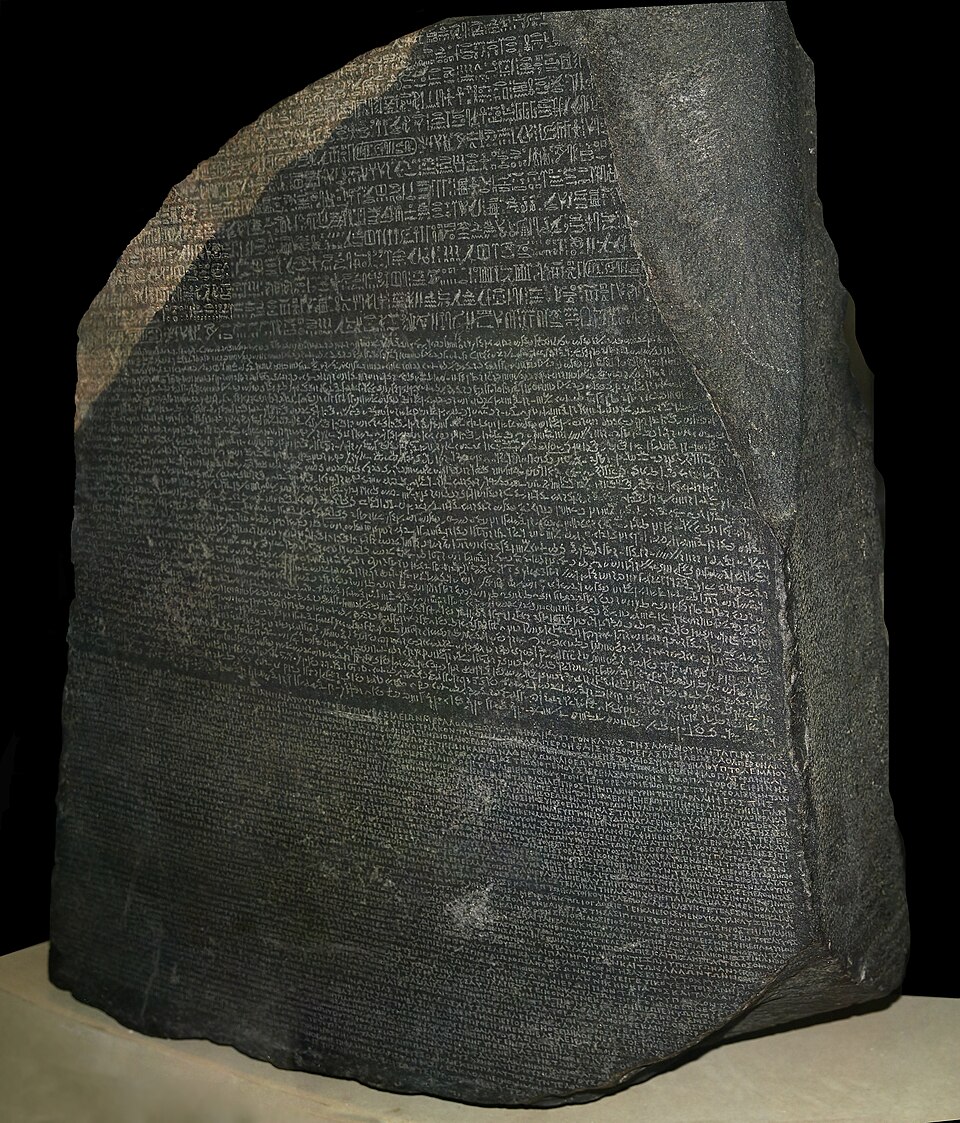
The Rosetta Stone, British Museum
Wikimedia Commons, Public Domain

The earliest known hieroglyphs appear on small ivory tablets from the tomb of King Scorpion I at Abydos, dated to approximately 3,200 BCE. The word "hieroglyph" is Greek for "sacred carving." Whether Egyptian writing was influenced by Sumerian cuneiform or arose independently remains debated among scholars. Hieroglyphs were used for over 3,500 years until the 4th century CE. Knowledge of them was lost until Jean-François Champollion deciphered the Rosetta Stone in 1822.

learnMore

The Rosetta Stone, discovered by Napoleon's soldiers in 1799, bears the same decree in three scripts: hieroglyphic, Demotic, and Greek. Champollion's breakthrough was recognizing that hieroglyphs were not purely symbolic but partly phonetic. The Egyptians also developed hieratic (a cursive shorthand) and later Demotic for everyday use — hieroglyphs were reserved for monumental and sacred contexts.

~1,300 BCE

Oracle Bone Script

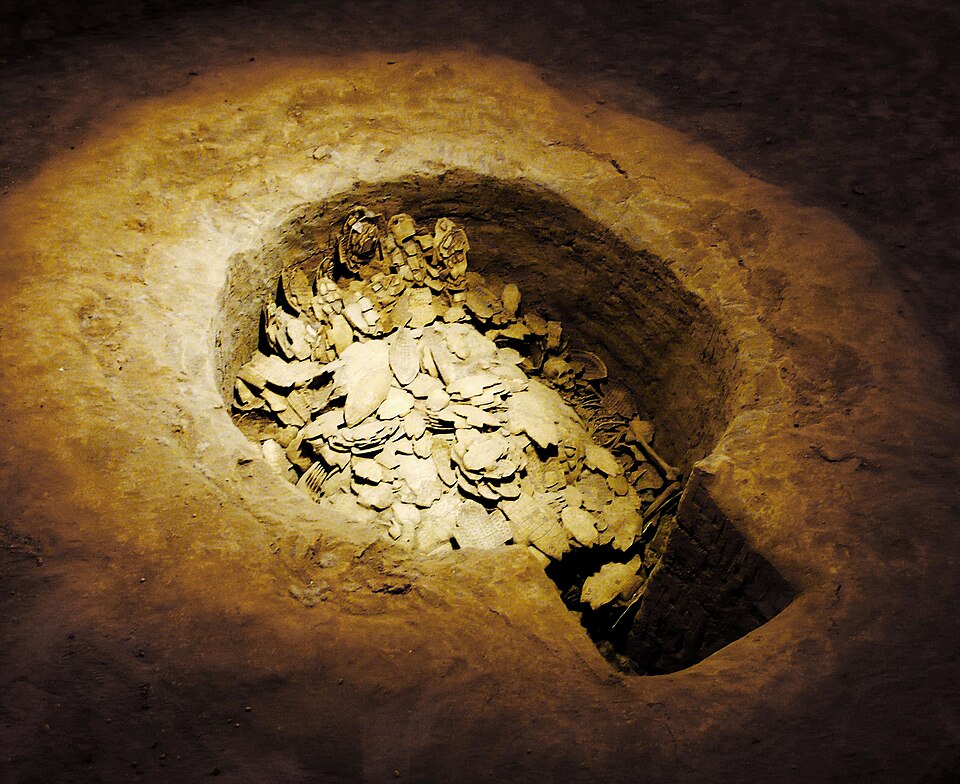
Oracle bone pit at Yinxu archaeological site, Anyang
Wikimedia Commons, CC BY-SA

During the Shang Dynasty, diviners carved questions onto tortoise shells and ox scapulae, then applied heat until the bones cracked. The cracks were interpreted as answers from ancestors. Radiocarbon dating places the inscriptions from King Wu Ding's reign to 1,254–1,197 BCE. The script was already a mature system of over 4,000 characters, implying centuries of earlier development. These characters evolved continuously over 3,000 years into the writing system used by over a billion people today — the longest unbroken lineage of any script.

learnMore

Oracle bones were rediscovered in 1899 when scholar Wang Yirong noticed inscriptions on "dragon bones" being sold as traditional medicine in Beijing. Subsequent excavations at Yinxu (near Anyang, Henan) unearthed over 150,000 fragments. Of the roughly 4,500 distinct characters identified, about 1,500 have been deciphered — the rest remain unknown.

The Alphabet

~1,850 BCE

Proto-Sinaitic Script

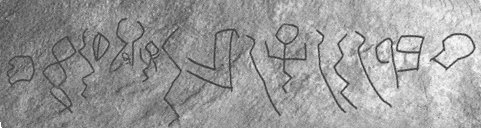
Wadi el-Hol proto-Sinaitic inscription
Wikimedia Commons, Public Domain

West Semitic laborers in the turquoise mines of Serabit el-Khadim (Sinai Peninsula) adapted about two dozen Egyptian hieroglyphs to represent the consonant sounds of their own language. Each symbol depicted a familiar object whose name began with the target sound — an ox head (ʾalp) for /ʔ/, a house (bayt) for /b/. This acrophonic principle was revolutionary: instead of hundreds of logograms, a small set of letters could spell any word. Proto-Sinaitic is the ancestor of virtually every alphabet in use today.

learnMore

The names of the letters themselves tell the story: "aleph" (ox), "beth" (house), "gimel" (camel), "daleth" (door). These Semitic words became the Greek "alpha, beta, gamma, delta" — and gave us the word "alphabet" itself. Writing systems like cuneiform and hieroglyphs required years of training in scribal schools; the alphabet could be learned by anyone in weeks.

~1,050 BCE

Phoenician Alphabet

The 22 letters of the Phoenician alphabet
Wikimedia Commons, CC BY-SA

The Phoenicians refined Proto-Sinaitic into a standardized 22-letter consonantal alphabet (abjad). Each letter represented a single consonant sound — no vowels, no logograms. Phoenician traders carried it across the Mediterranean from their city-states of Tyre, Sidon, and Byblos. It was adopted and adapted by the Aramaeans, Hebrews, Arabs, Greeks, and eventually spread to nearly every literate civilization. The modern Arabic, Hebrew, Greek, Latin, and Cyrillic scripts all trace their lineage here.

learnMore

The city of Byblos was so closely associated with writing that the Greeks named it after their word for papyrus (byblos), which in turn gave us the word "Bible" — literally "the book." Aramaic script, derived from Phoenician, became the administrative writing of the Persian Empire and the ancestor of scripts used from India (Brahmi) to Mongolia.

~800 BCE

Greek & Latin Alphabets

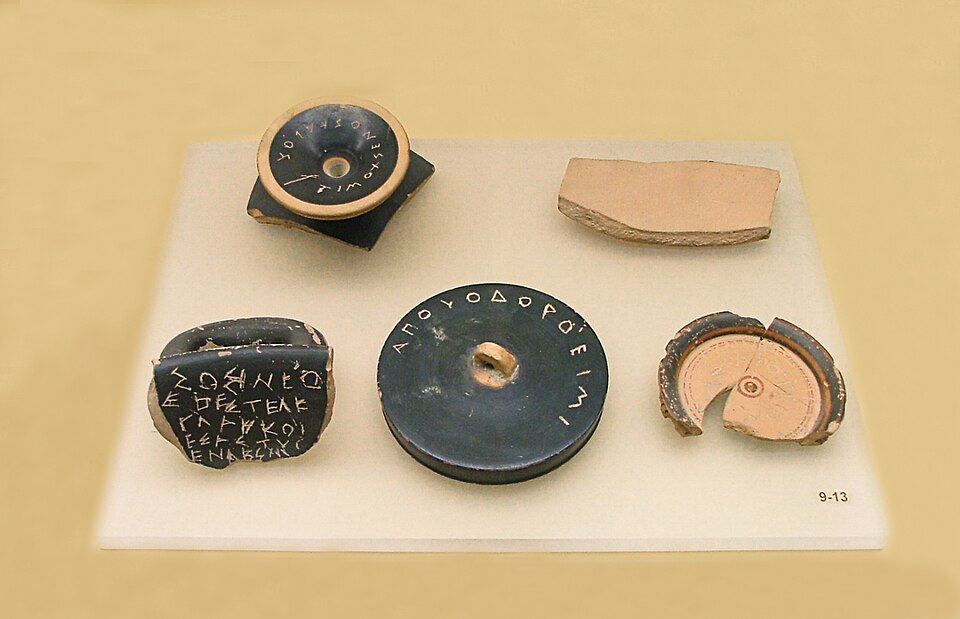
Fragments of ancient Greek pottery with inscriptions, Agora Museum Athens
Wikimedia Commons, CC BY-SA

The Greeks made a critical innovation: they repurposed unused Phoenician consonant letters to represent vowels, creating the first script that could fully and unambiguously record every sound in a language. This enabled the precise written transmission of Homer's epics, Plato's philosophy, and Euclid's geometry. The Etruscans adapted the Greek alphabet for their language, and the Romans further modified it into Latin script — the 26 letters now used to write English, Spanish, French, German, and hundreds of other languages worldwide.

learnMore

The original Greek alphabet had several regional variants. Athens adopted the Ionic variant in 403 BCE, which became standard. The Romans dropped some Greek letters (Θ, Φ, Χ) and added others. The letters J, U, and W were medieval additions — the Romans wrote with only 23 letters. Latin script's global dominance today owes as much to the Roman Empire's reach as to later European colonialism.

Surfaces & Instruments

~3,000 BCE – 2nd c. BCE

Papyrus & Parchment

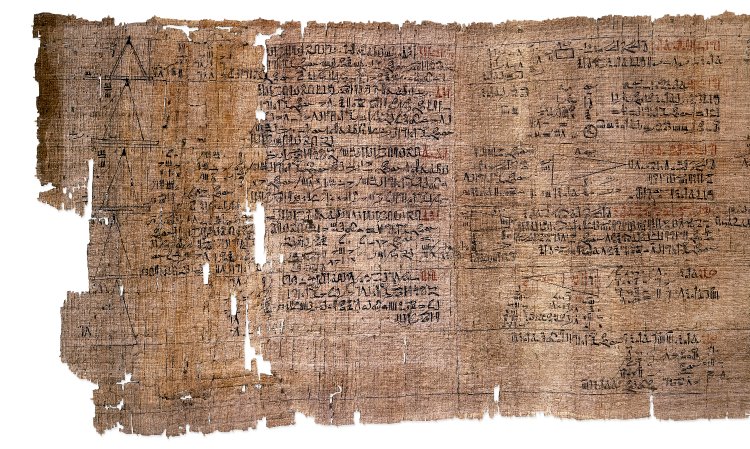
Rhind Mathematical Papyrus, British Museum
Wikimedia Commons, Public Domain

The Egyptians manufactured papyrus from the aquatic Cyperus papyrus plant around 3,000 BCE, creating the first lightweight, portable writing surface. Papyrus sheets could be glued into scrolls up to 40 meters long and remained in use for nearly 4,000 years. In the 2nd century BCE, tradition credits King Eumenes II of Pergamum with developing parchment (processed animal skin) as an alternative when papyrus supply from Egypt was restricted. Parchment was more durable, could be written on both sides, and was eventually bound into the codex — the ancestor of the modern book.

learnMore

The shift from scroll to codex (bound pages) happened gradually between the 1st and 4th centuries CE. A scroll must be unrolled sequentially; a codex allows random access to any page — a seemingly simple change that made indexing, cross-referencing, and quick lookup possible. Early Christians adopted the codex format enthusiastically, which helped drive its spread across the Roman world.

105 CE

Paper

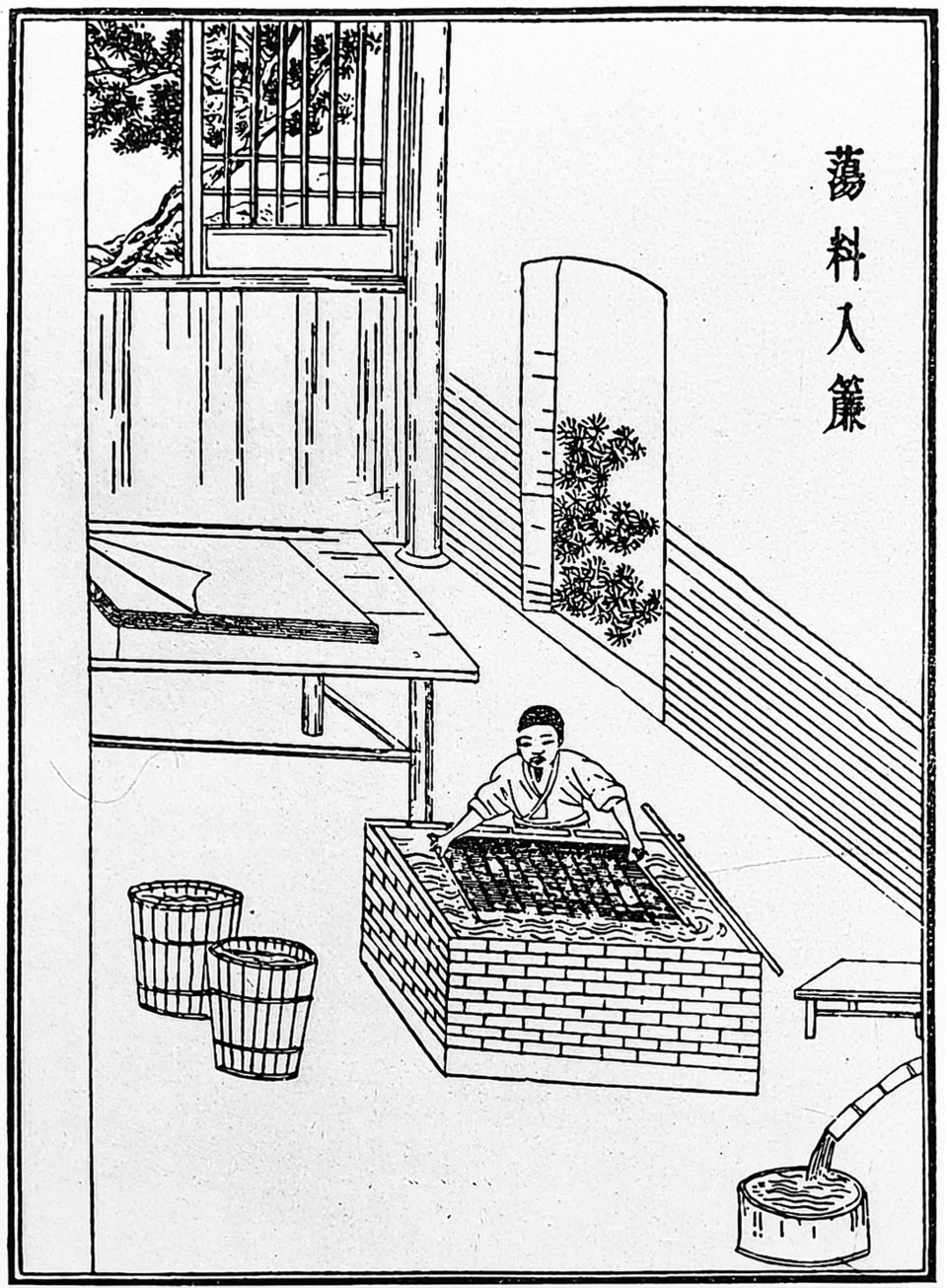
Ancient Chinese papermaking: casting the paper pulp, as described by Cai Lun in 105 CE
Wikimedia Commons, Public Domain

In 105 CE, the Han Dynasty court official Cai Lun reported to Emperor He a refined process for making paper from tree bark, hemp, old rags, and fishing nets. While archaeological evidence suggests cruder paper existed in China as early as the 2nd century BCE, Cai Lun's method produced a writing surface of unprecedented quality and affordability. Paper spread westward along the Silk Road: reaching Samarkand after the Battle of Talas (751 CE), Baghdad by the late 8th century, Islamic Spain by the 12th century, and becoming common across Europe by the 15th century — just in time for the printing press.

learnMore

The Battle of Talas (751 CE) between the Tang Dynasty and the Abbasid Caliphate is often cited as the event that brought papermaking west — captured Chinese craftsmen reportedly taught the technique to their captors. Baghdad's first paper mill opened around 793 CE. By the 14th century, paper mills operated across Italy, France, and Germany. Paper was 5 to 10 times cheaper than parchment, making Gutenberg's revolution economically viable.

~600–1400 CE

Illuminated Manuscripts

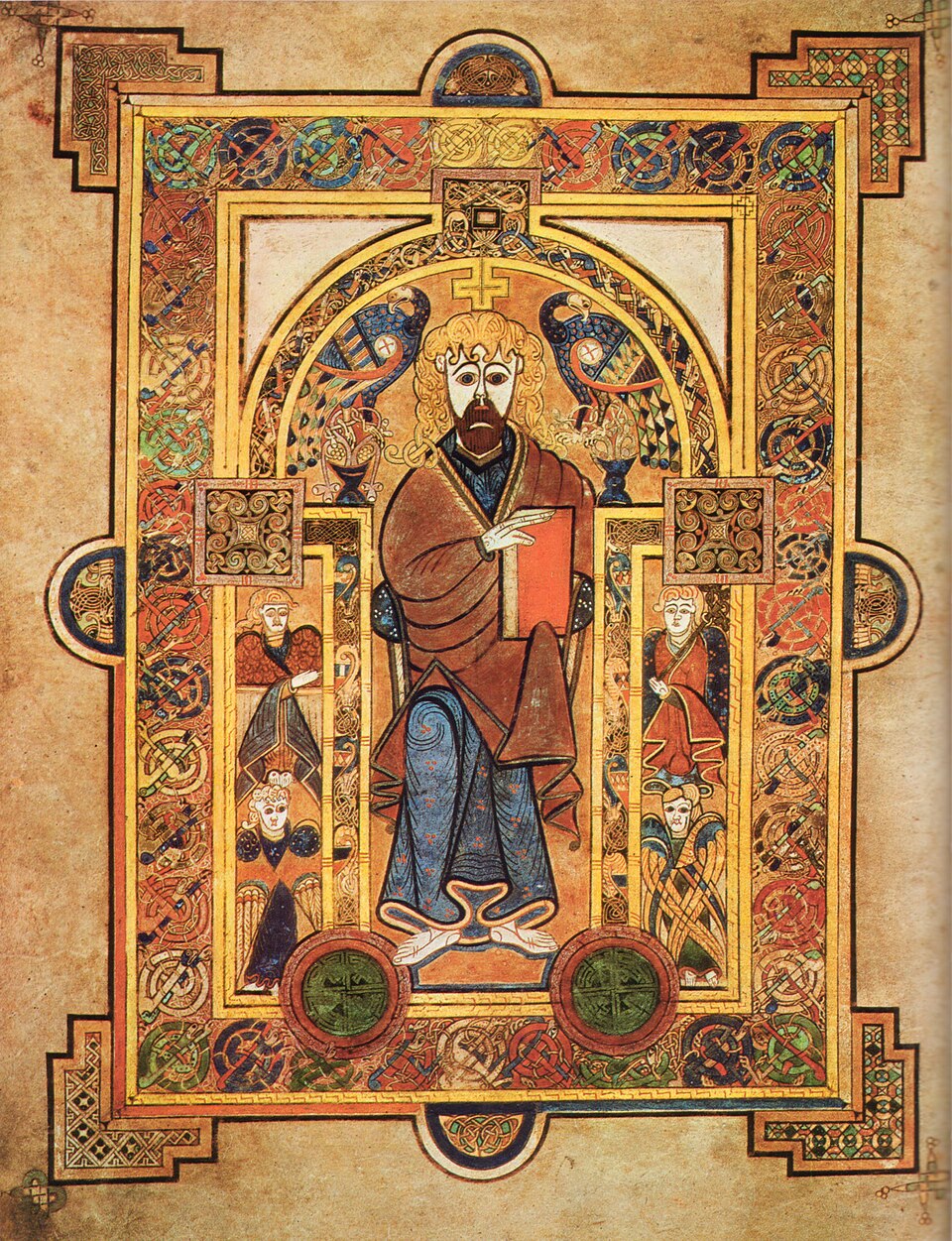
Book of Kells, Folio 32v, Christ Enthroned, c. 800 CE
Wikimedia Commons, Public Domain

In medieval monasteries, monks copied texts by hand using quill pens on vellum (calfskin parchment), adorning pages with gold leaf, lapis lazuli, and vermillion. The Book of Kells (~800 CE, Ireland) and the Lindisfarne Gospels (~700 CE, England) represent the pinnacle of this tradition. In the Islamic world, calligraphers elevated Arabic script into a refined art form governed by strict geometric principles. In East Asia, brush calligraphy became both art and meditative discipline. For a thousand years, the manuscript was the sole vessel of written knowledge in the West.

learnMore

A single manuscript could take years to produce. The Codex Amiatinus (c. 700 CE), the oldest surviving complete Latin Bible, required the skins of approximately 1,550 calves. Monastic scriptoria operated with strict rules of silence; errors were corrected by scraping the vellum with a knife. The quill pen, typically made from a goose feather, was the dominant writing instrument in Europe from roughly 600 CE to the 1820s.

The Print Revolution

~1440 CE

Gutenberg's Press

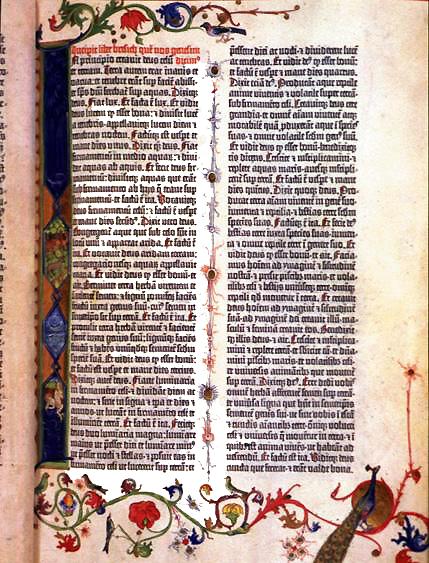
Page from the Gutenberg Bible, c. 1455
Wikimedia Commons, Public Domain

Around 1440, Johannes Gutenberg, a goldsmith from Mainz, Germany, combined four innovations: movable metal type cast from a lead-tin-antimony alloy, oil-based ink, a hand mould (matrix) for mass-producing individual letters, and a wooden press adapted from wine and olive presses. His workshop could produce approximately 3,600 pages per day, compared to 40 by hand-copying. The Gutenberg Bible (1455) demonstrated the technology's potential. By 1500, an estimated 20 million volumes had been printed across Europe. The press fueled the Renaissance, enabled the Protestant Reformation, and laid the foundation for the Scientific Revolution.

learnMore

China and Korea developed movable type centuries earlier — Bi Sheng created ceramic movable type around 1040 CE, and Korea produced metal type by the 13th century. Gutenberg's innovation was the complete system: the hand mould enabled rapid, standardized type production at scale. Within 50 years of his Bible, over 1,000 print shops operated across Europe. Martin Luther's Ninety-Five Theses (1517) spread across Germany in two weeks — something impossible before the press.

1868 CE

The Typewriter

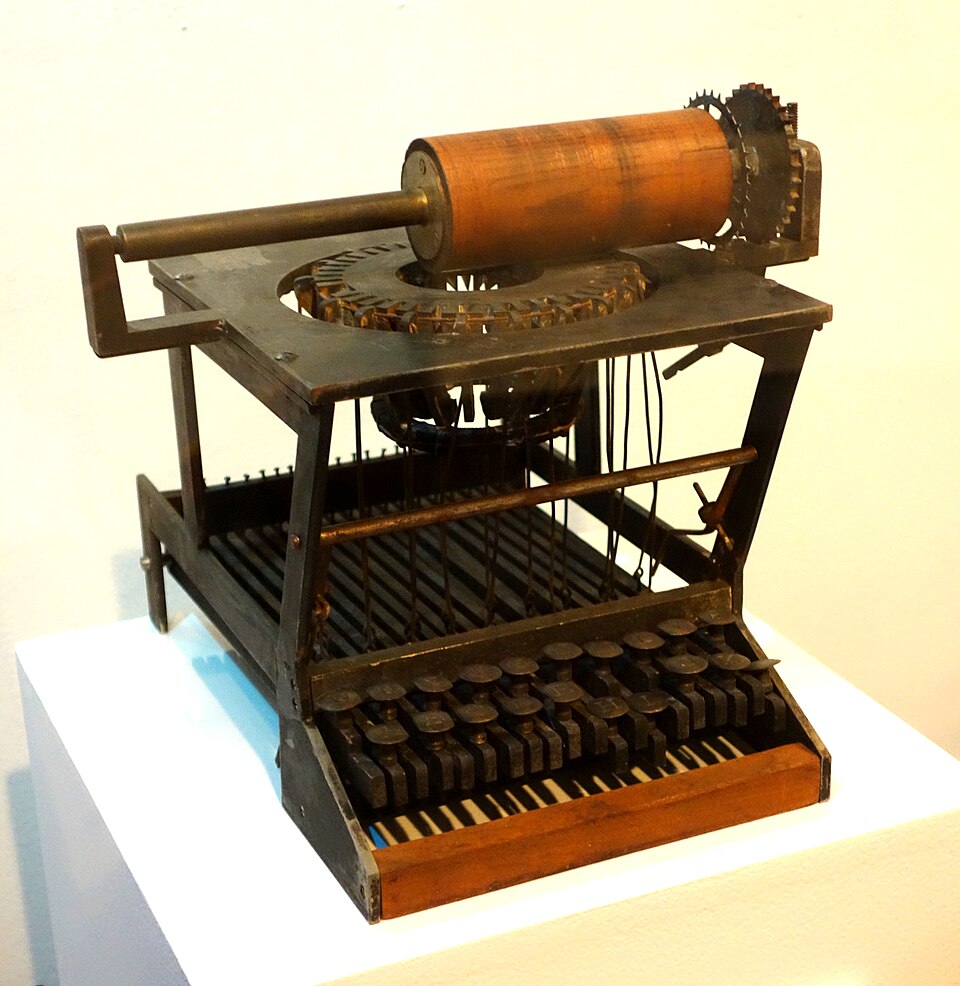
Sholes and Glidden typewriter prototype, c. 1870, Wisconsin Historical Museum
Wikimedia Commons, CC0

On June 23, 1868, Christopher Latham Sholes, Carlos Glidden, and Samuel Soule patented the first practical typewriter. E. Remington and Sons began manufacturing in Ilion, New York in 1873, and the first commercial models went on sale in 1874. The typewriter established the QWERTY keyboard layout — still standard on every keyboard today. It also transformed the workforce: by the 1880s, typing became one of the first office jobs widely open to women. Mark Twain submitted the first typewritten book manuscript (Life on the Mississippi, 1883).

learnMore

The QWERTY layout was designed to prevent jamming on mechanical typewriters by separating commonly paired letters. Remington's early models typed only in uppercase; the shift key was introduced in 1878. By 1900, the word "typewriter" referred both to the machine and the person (usually a woman) who operated it. Notable authors who composed on typewriters include Hemingway, Kerouac, and Plath.

The Digital Word

1971 CE

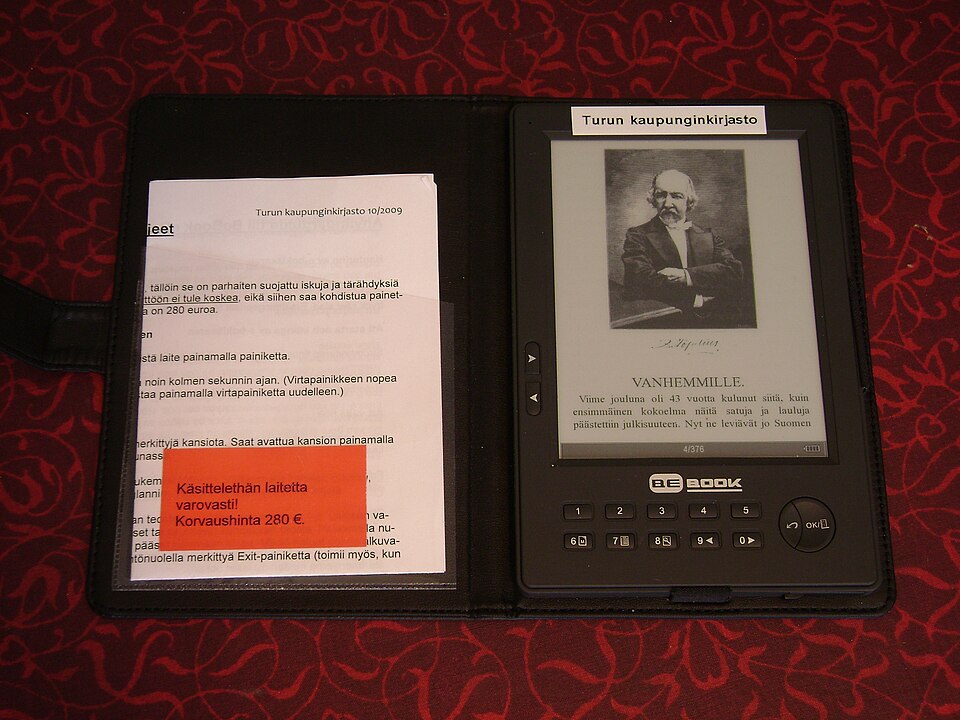
The First E-Book

An early e-book reader device
Wikimedia Commons, CC BY-SA

On July 4, 1971, Michael Hart, a student at the University of Illinois, typed the United States Declaration of Independence into a mainframe computer and distributed it over ARPANET. This act created Project Gutenberg — the world's first digital library. For the first time in history, a written text existed not on paper, parchment, or clay, but as pure digital information: weightless, infinitely copyable, and free to distribute.

learnMore

Hart chose the Declaration of Independence because it was July 4th. Project Gutenberg now hosts over 70,000 free e-books. The first word processors appeared around the same time: IBM's Magnetic Tape Selectric Typewriter (1964) and Wang Laboratories' CRT-based system (1976). Microsoft Word launched in 1983. By the 1990s, most professional writing had migrated from paper to screen.

1989 CE

The World Wide Web

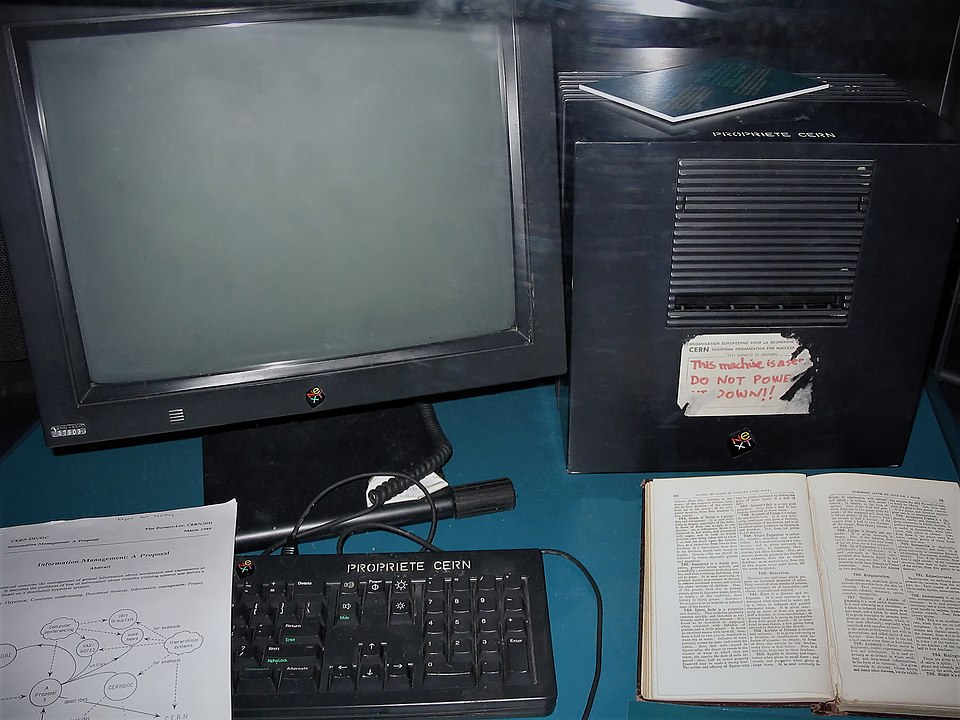
The first web server at CERN, a NeXT computer used by Tim Berners-Lee
Wikimedia Commons, CC BY-SA

In March 1989, Tim Berners-Lee, a British physicist at CERN, proposed a system of interlinked hypertext documents accessible via the internet. By December 1990, he had built the first web browser, web server, and web page. The first publicly accessible website went live on August 6, 1991. The Web transformed writing from a one-to-many broadcast (author to readers) into a many-to-many conversation. Anyone with an internet connection could publish globally — no publisher, no editor, no gatekeeper.

learnMore

Berners-Lee's original proposal was titled "Information Management: A Proposal." His supervisor at CERN wrote "Vague but exciting" on the cover page. The first website (info.cern.ch) described the World Wide Web project itself. Crucially, CERN released the Web's underlying technology royalty-free in 1993 — had it been patented, the open web as we know it might never have existed.

Writing Everywhere

1999–2003 CE

Blogs

WordPress admin dashboard interface
Wikimedia Commons, CC BY-SA

The term "weblog" was coined by Jorn Barger in December 1997; Peter Merholz shortened it to "blog" in 1999. Platforms like Blogger (1999), LiveJournal (1999), and WordPress (2003) eliminated the technical barrier to online publishing. By the mid-2000s, millions of people who had never considered themselves writers were publishing essays, diaries, and commentary to a global audience. Blogging revived long-form personal writing and created entirely new forms of journalism, criticism, and public discourse.

learnMore

Blogger was acquired by Google in 2003. WordPress, originally a blogging tool, now powers over 40% of all websites on the internet. The term "blogosphere" entered common usage around 2004. Blogs played a notable role in political discourse — during the 2004 U.S. election, bloggers fact-checked mainstream media in real time, a dynamic that foreshadowed social media's later influence.

2006–2012 CE

Social Media & Micro-Writing

Social media app icons on a smartphone screen
Wikimedia Commons, CC BY-SA

Twitter launched on July 15, 2006 with a 140-character limit, creating a new literary constraint. Facebook (2004), Instagram (2010), and WeChat (2011) turned billions of people into daily writers. Writing became fragmented, immediate, and conversational. By 2012, humanity was producing more written text per day than in entire centuries of pre-digital history — status updates, comments, messages, reviews. The volume was unprecedented; the average length, historically tiny.

learnMore

Twitter's 140-character limit was dictated by SMS's 160-character ceiling, minus 20 characters for the username. It doubled to 280 in 2017. The hashtag (#) was proposed by user Chris Messina in 2007 — Twitter initially rejected it as "too nerdy." WeChat (Weixin) launched in China in 2011 and now has over 1.3 billion monthly active users, functioning as a combined messaging, social media, and payment platform.

2022 CE →

AI & the Future of Writing

GPT reasoning interface for text generation
Wikimedia Commons, CC BY-SA

On November 30, 2022, OpenAI released ChatGPT, a large language model capable of generating coherent, contextually appropriate text across genres. Within two months it reached 100 million users — the fastest adoption of any technology in history. AI can now draft, edit, translate, summarize, and generate code. The boundary between human-written and machine-generated text has become difficult to discern. Forty thousand years after the first hand was pressed against a cave wall, writing faces its most fundamental question: what does authorship mean when machines can write?

learnMore

Large language models work by predicting the next token (word fragment) based on statistical patterns learned from vast text corpora. GPT-3 (2020) was trained on roughly 570 GB of text; GPT-4 (2023) is believed to be significantly larger. The underlying transformer architecture was introduced in the 2017 paper "Attention Is All You Need" by researchers at Google. AI-generated text is now used in journalism, legal drafting, academic research, and software development — raising unresolved questions about copyright, attribution, and intellectual property.